Eupsychian Management Maslow Pdf Converter
PDF The paper introduces Maslow's utopian vision of managing people at work. Drawing upon the notion of self-actualization, Maslow coined the term 'Eupsychia'. The Maslow Business Reader collects Maslow's essays and letters for his many devoted adherents, and introduces his published and unpublished works to readers unfamiliar with Maslow's management breakthroughs.
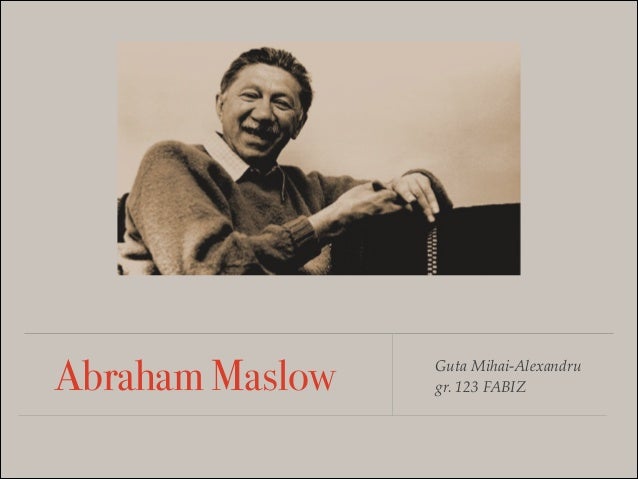
Abraham Maslow was always looking at the 'big picture.' Whereas most social scientists of his day seemed to wear blinders that riveted their to narrow concerns, Maslow's own vision was far-reaching. His lifetime of discoveries in and transcended academic psychology, and extended into the major business fields of. Maslow also loved to explore nascent, barely perceptible social trends and to speculate boldly about their consequences. As the originator of such important ideas as the hierarchy of human needs, self-actualization, higher motivation, team, and business synergy, Maslow was well-respected at the time of his sudden death in 1970. Back then, he was already acclaimed as a founder of the approach known as enlightened management.
Yet, in the intervening decades, Maslow's reputation and relevance have increased, rather than diminished. His concepts not only continue to shape the United States, but exert increasing international impact as well. As simply one academic indicator, Maslow's volume of posthumously published essays, FUTURE VISIONS, which I edited, has been translated into Chinese, Japanese, and Spanish.
Why do normally staid business writers venerate Maslow and refer to him as a 'legendary' psychologist? In an era of organizational and social fads, what gives his wide-ranging work such impressive staying power? And, why is his star still rising, when so many others' have fallen to obscurity? I can offer three separate but interrelated answers that seem sensible to me. First, Maslow's approach to the 'human side of business' is grounded solidly in research. Even when he was most speculative concerning psychologically healthy, high-achieving men and women, Maslow kept close to available data.
He rarely ventured opinions, especially in public, when lacking scientific corroboration, however sketchy or tentative. Despite his pleasure in making intuitive leaps, he read voluminously across many scientific fields: from anthropology and sociology to biology and endocrinology. Thus, while certainly a visionary in the true sense of the term, Maslow always took pride in presenting his ideas soberly and responsibly. Second, if it's a truism to say that every management approach is based implicitly on psychology--that is, on a particular view of human nature--then it's no accident that Maslow's perspective remains so potent. Integrating all competing motivational theories into a single metasystem, he successfully unified what had previously been a huge but fragmented, and seemingly self-contradictory body of findings. Later motivational work, such as advanced by Edward Deci and Richard Ryan concerning self-determination theory, is highly consistent with Maslow's viewpoint on intrinsic motivation. 